Thursday, May 28, 2015
Why do shampoo bottles have French translations?
Shampoo bottles found in the U.S. typically provide both English and French translations. While not commonly spoken in the U.S., French is pervasive in Canada. In order to save on production and distribution costs, shampoo companies often use the same bottles in the U.S. and Canada. Since Canada's Consumer Packaging and Labeling Act requires both French and English translations on products sold in Canada, shampoo companies include both languages.
Monday, December 23, 2013
What does "from concentrate" mean?
Sunday, December 22, 2013
How do auto-dimming car mirrors work?
Saturday, December 21, 2013
Why is there no E grade in the grading scale?
The letter-based system used today in many primary, secondary, and post-secondary schools was first used at Mount Holyoke College in 1897, with the exception that it used an E rather than F. Despite Mount Holyoke having the first complete A-E system, Harvard allegedly handed out a B grade in 1883. The letter-based grading scale at Mount Holyoke worked by assigning each letter a numerical range (e.g. A being 90-100), with E representing failure. Eventually, as the A-E grading scale became more popular, the E was dropped and replaced by an F because the letter F more logically denotes failure. The other letters in the system, A, B, C, and D, represent the four possible passing grades.
Friday, December 14, 2012
Where did the term "cup of joe" come from?
Today, the phrase "cup of joe" is just another way of saying "cup of coffee." In fact, there is even a coffee shop called Cup o' Joe. The phrase first appeared in print around 1930 and has since popularized. Though the exact origin of the phrase is unknown, there are three common theories that purport to have the answer. The first theory suggests that "cup of joe" is a byproduct of the 1860 song "Old Black Joe" by Stephen Foster. Given that the song fails to mention coffee and that the phrase "cup of joe" did not appear in print until 70 years later, this theory is likely not true.
The second theory holds that the phrase appeared as a result of the 1914 ban of officers' wine messes on U.S. naval ships imposed by admiral Josephus "Joe" Daniels. Since wine messes were no longer available on naval ships, officers would turn to coffee as a substitute. Accordingly, the theory holds, coffee became known as '"joe" after the man who, though indirectly, popularized it. This theory faces similar problems as the first: the ban on officer wine messes occurred prior to 1930 and, more importantly, the 1914 ban only eliminated wine messes for officers, having little effect on the coffee consumption of non-officer seamen who, since 1862, had faced a ban of alcohol on naval ships.
The third and most tenable theory holds that "joe" is derived from "java" or "jamoke," two common substitutes for "coffee" around 1930. The word "jamoke"was already a combination of java and mocha, so why not shorten it to "joe"?
Wednesday, December 5, 2012
Why are there colored dots on soda cans?
The colored dots found on aluminum soda cans near the nutrition information consist of all of the colors used in the can design. Of course, these colors vary depending on the design of the can. During manufacturing, a number of different machines apply color to each can; usually, each machine uses only one color. If a can makes it through production and its red dot, for example, is faded or absent, then laborers will be able to trace the problem to the single machine applying red color, without shutting down all of the machines to resolve the problem.
Monday, December 3, 2012
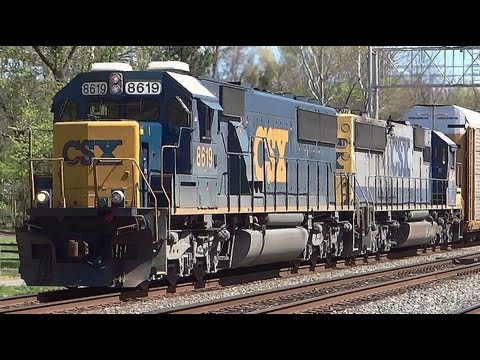
Why do some locomotives run backward?
Trains carrying large loads are usually pulled by two or three locomotives, collectively called a locomotive consist. Usually, the first locomotive is facing forward and the other locomotives are facing backward. This seemingly odd phenomenon is actually a common and convenient practice in the railroad industry. The leading locomotive faces forward to allow the conductor to see the path ahead and follow various signals. The second (and sometimes third) locomotive usually faces backward for the sake of convenience. Modern locomotives are able to run both "forward" and "backward" without compromising efficiency. That being said, by positioning a second locomotive backward behind a leading locomotive, a convenient pair is formed. Having a locomotive facing each direction allows for quick turnarounds, as the backward locomotive can quickly serve as the leading locomotive when necessary. The efficacy of this pairing is what makes it a standard practice in the rail industry today.
Subscribe to:
Posts (Atom)